
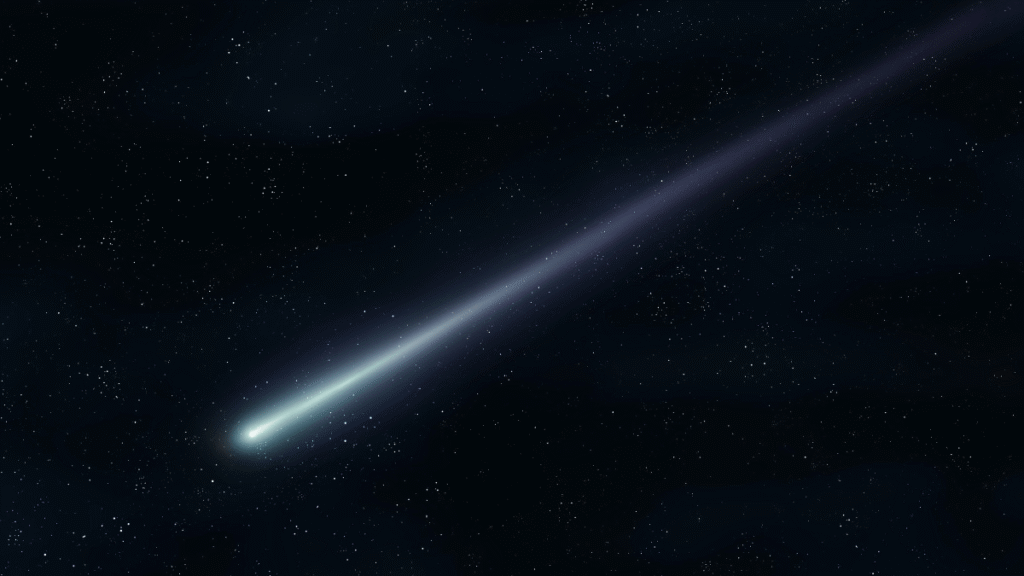
Nobody at the ATLAS telescope in Chile was hunting for a visitor from another star on July 1, 2025. Their job is to catch asteroids that might threaten Earth. What showed up that night was a faint dot moving far too fast, and it didn’t take astronomers long to work out that it wasn’t from around here.
Where It Came From
NASA says the telescope that caught it sits in Rio Hurtado, Chile, and belongs to the agency’s planetary defense network. The “3I” in the name marks it as only the third interstellar object anyone has spotted, after ‘Oumuamua in 2017 and 2I/Borisov in 2019. Its speed and its path settled the question of origin. Anything that belongs to the Sun simply doesn’t move that way.
The Part That Surprised Everyone
Then came the age estimate. Researchers think this thing could be at least 7 billion years old, older than our solar system. So we may have been looking at a chunk of ice that formed around some other star before the Sun even existed.
It didn’t look like the comets we know, either. The James Webb Space Telescope found it loaded with carbon dioxide, far more than usual. Live Science reported it was dumping water into space so quickly that researchers compared it to a fire hose.
How Big, How Fast
Hubble took a look on August 20, 2025. The best scientists could say is that the solid core is somewhere between 1,400 feet and 3.5 miles wide, because the cloud of gas and dust around it hides the rest. On October 29 it swung past the Sun doing about 153,000 miles per hour.
Did It Ever Threaten Earth?
Not even close. Its nearest pass came on December 19, 2025, and it was still about 170 million miles away. That’s almost twice as far as the Sun is from us.
So, Was It Aliens?
A lot of people online wanted it to be. Harvard astrophysicist Avi Loeb kept the idea alive by openly asking whether it could be alien technology. NASA never bought it. The agency says the color, speed and direction all fit a comet. A jet of gas pointing at the Sun got plenty of attention too, but an expert told Live Science that comets do that all the time.
Why Scientists Still Care
The comet is gone now, and it isn’t coming back. What it left behind is a pile of data. NASA says the ways it differs from our own comets are exactly what make it worth studying. For a few months, astronomers got to examine material from another star system without ever leaving home.