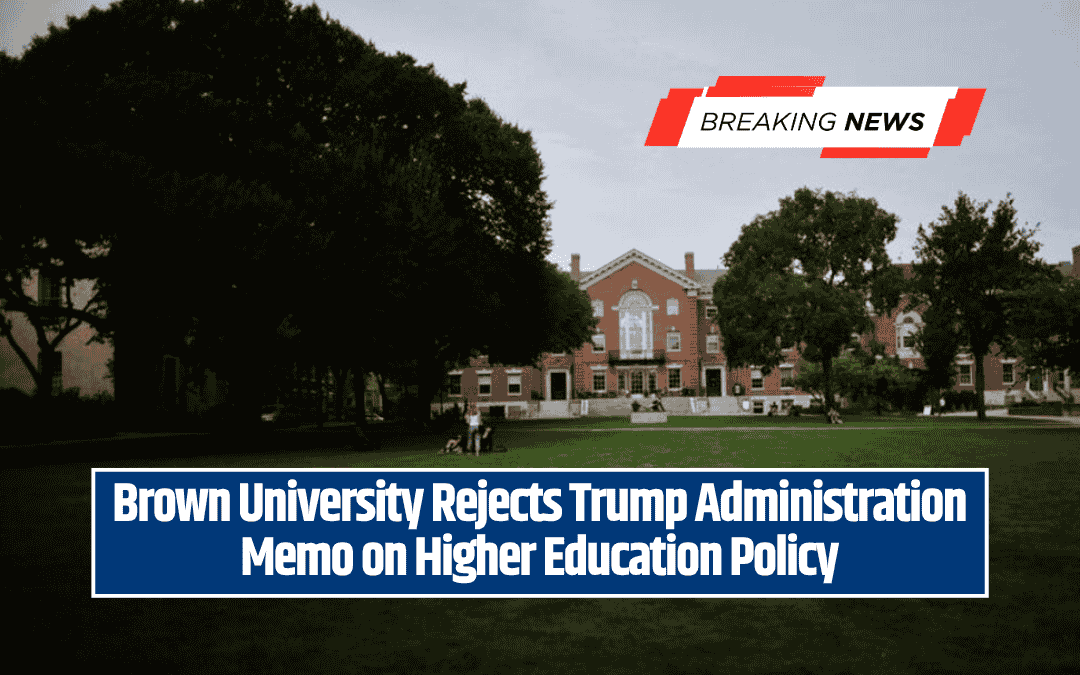
PROVIDENCE, R.I. — Brown University President Christina Paxson said Wednesday that the Ivy League institution will not sign a Trump administration memo that lays out strict conditions for universities seeking preferential treatment in federal funding.
Brown becomes the second elite school, after the Massachusetts Institute of Technology, to reject the proposal.
The Memo’s Demands
The document, titled “A Compact for Academic Excellence in Higher Education,” was sent to nine elite universities. It called on schools to limit international undergraduate enrollment to 15%, ban the use of race or sex in hiring and admissions, and define gender strictly by biological criteria.
In return, compliant institutions could receive enhanced consideration for federal contracts and grants.
Federal Funding as Leverage
According to the memo, universities that “pursue models and values” not aligned with the administration’s standards could lose access to federal benefits.
The White House has already canceled millions of dollars in federal contracts with several institutions to pressure them into changing their admissions and hiring policies. However, courts have ordered many of those cuts to be reversed.
Paxson’s Letter to Washington
In a letter addressed to Education Secretary Linda McMahon, Paxson said signing the compact would violate Brown’s principles of academic freedom and self-governance.
“Accepting the memo’s terms would restrict academic freedom and undermine the autonomy of Brown’s governance,” she wrote. Paxson emphasized that the new proposal contradicted an earlier agreement Brown reached with the administration in July.
A Prior Deal Already in Place
That July 2025 agreement required Brown to contribute $50 million over a decade toward workforce development initiatives in Rhode Island.
In exchange, the administration restored federal funding for Brown’s medical and health sciences programs—funding that had been suspended earlier amid disputes over campus diversity and free-speech policies.
“A Principle Not Reflected in the Compact”
Paxson said the July deal clearly stated that the federal government “has no authority to dictate curriculum or academic content.” She warned that the latest memo ignored this principle, raising concerns about federal overreach into university governance.
“This compact,” she wrote, “would fundamentally compromise the independence of American higher education.”
White House Defends the Initiative
White House spokesperson Liz Huston defended the administration’s proposal, calling it a step toward “restoring academic excellence and common sense.”
In a written statement, she said, “President Trump is committed to ensuring that America’s higher education institutions promote fairness and merit-based opportunity. Any university that joins this historic effort will help shape the nation’s future.”
Trump’s Push Against “Left-Wing Extremism”
President Donald Trump has repeatedly criticized universities for what he calls “left-wing extremism” and “anti-American indoctrination.”
Over the weekend, he wrote on social media that his administration would “crack down on schools that continue to illegally discriminate based on race or sex” and invited colleges to enter into new “forward-looking agreements” with the federal government.
MIT Set the Precedent
MIT became the first of the nine targeted universities to publicly decline the compact last week. Officials there cited concerns over free inquiry and academic independence, warning that compliance could open the door to political interference in research and education.
Brown’s decision now signals growing pushback among elite universities against federal influence in campus governance.
A Broader Battle Over Academic Freedom
The administration has not reached out to additional schools beyond the original nine universities, the White House confirmed. Still, higher education leaders say the conflict reflects a broader struggle over academic freedom, diversity, and federal control.
For now, Brown and MIT stand as the first to publicly refuse what they view as a threat to institutional autonomy.