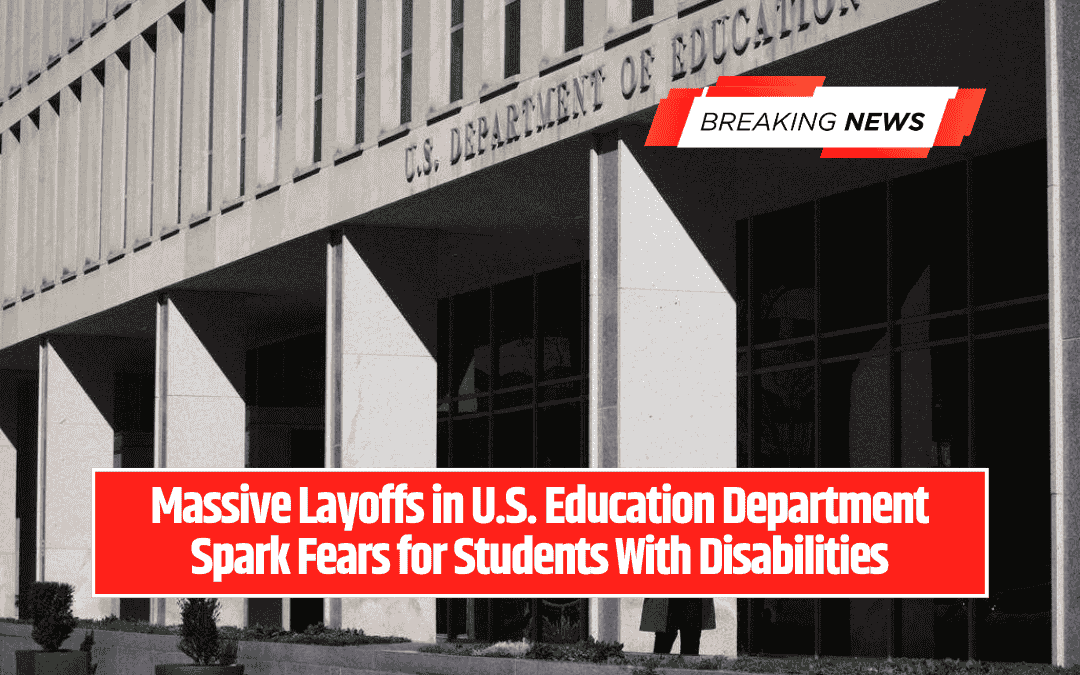
FORT WORTH, Texas — Families of students with disabilities are expressing deep concern after the Trump administration announced sweeping layoffs within the U.S. Department of Education, including nearly every staff member in the office responsible for enforcing federal special education law.
The cuts, announced last week amid a government shutdown entering its third week, affect 466 department employees, including most of the Office of Special Education and Rehabilitative Services (OSERS).
Advocates warn the move could effectively end federal enforcement of the Individuals with Disabilities Education Act (IDEA) for the first time in nearly 50 years.
“This is devastating,” said Jill Jorgensen, a Fort Worth mother of a student with disabilities and president of the Fort Worth ISD Special Education PTA. “Families like ours are already exhausted trying to navigate the system. We shouldn’t have to become lawyers and activists just to get help.”
Cuts Threaten Key Protections Under Federal Law
Passed in 1975, IDEA guarantees all students with disabilities a “free and appropriate public education.” It also requires schools to educate students in the least restrictive environment possible. Enforcement of these rights falls to OSERS, which monitors states’ compliance and intervenes when violations occur.
Blair Wriston, senior government affairs manager at the Education Trust, warned that the layoffs could leave no one at the federal level to hold states accountable.
“Without staff to enforce IDEA, families have few options if their rights are violated,” he said. “Even the basic technical assistance — the ability to call Washington for guidance — will disappear.”
Texas, in particular, has a troubled history with IDEA compliance. In 2018, the Education Department found that the Texas Education Agency had illegally capped special education enrollment at 8.5% of total students.
The U.S. Fifth Circuit Court of Appeals also ruled that Texas underfunded special education programs by more than $41 million that same year, leading to federal funding penalties.
Advocates Warn of Disproportionate Impact on Vulnerable Students
Disability rights advocates fear that the fallout will hit the most vulnerable students hardest. Studies show that students of color with disabilities face higher rates of disciplinary action and are more likely to be segregated from mainstream classrooms.
“If federal enforcement disappears, these students lose a vital layer of protection,” Wriston said. “We risk turning back decades of progress.”
The long-term funding implications are also unclear. When Congress enacted IDEA, it committed to covering 40% of special education costs nationwide — a promise never fulfilled. Federal funding has consistently covered less than 15% of total expenses, leaving states and districts to shoulder most of the burden.
This year, Texas received $953.4 million in federal special education funding. Districts like Arlington ISD, which received $12.1 million, say that current funding for the school year is secure but worry about future cycles.
“We will continue to monitor developments so we can serve our students,” said Taina Northington, spokesperson for Arlington ISD. “But any disruption in oversight or funding creates uncertainty for families and educators.”
Parents Brace for More Challenges
For families in districts like Fort Worth ISD, where resources are already stretched thin, the cuts add another layer of anxiety. Jorgensen said she often encounters resistance when requesting support for her child.
“You get a ‘no’ first,” she said. “Then you have to keep pushing. It shouldn’t be this hard.”
She fears that if federal oversight weakens further, school districts under financial pressure could more easily deny services to students who need them most. “If the funding disappears, they’ll say they can’t afford it — and kids will pay the price,” Jorgensen said.
A Fragile System at Risk
While the Individuals with Disabilities Education Act remains law, advocates warn that laws mean little without enforcement. The layoffs leave parents, teachers, and districts without a critical partner in ensuring compliance.
“This is not just a bureaucratic change,” Wriston said. “It’s a dismantling of the system that guarantees equal education for millions of children with disabilities.”
For families like the Jorgensens, that dismantling feels personal. “These protections are supposed to level the playing field,” she said. “If no one’s left to enforce them, what happens to our kids?”