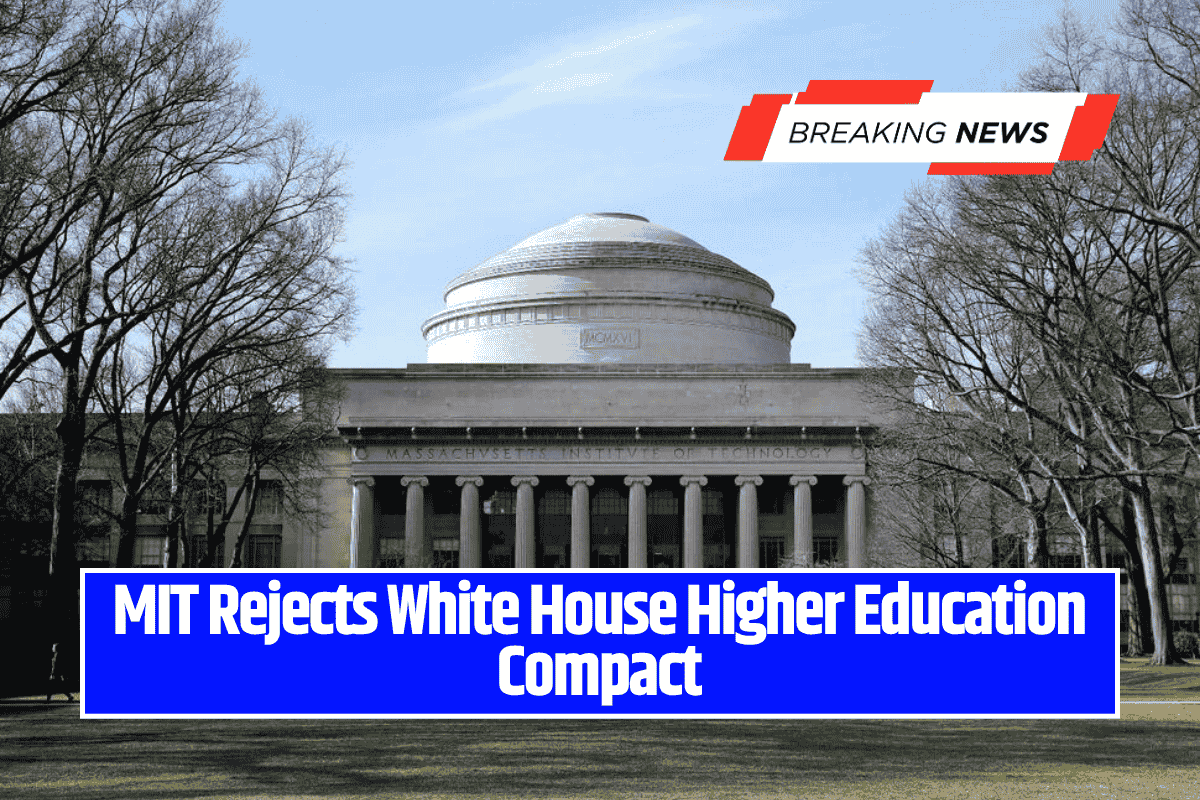
The president of the Massachusetts Institute of Technology (MIT), Sally Kornbluth, stated on Friday that the university “cannot support” a White House proposal that would require universities to adopt President Donald Trump’s political agenda in exchange for favorable access to federal funding.
In a letter to Education Secretary Linda McMahon and other officials, Kornbluth emphasized that MIT rejects provisions of the proposal that would limit free speech and institutional independence, arguing that scientific funding should be based on merit rather than political alignment.
Although her letter did not explicitly decline the compact, Kornbluth suggested its terms were “unworkable.”
She reaffirmed that MIT’s policies—such as reinstating standardized testing and providing tuition-free education for families earning under $200,000—are voluntary reflections of institutional values, not concessions to federal mandates.
The White House Compact and Its Terms
The 10-page proposal, sent to nine universities including MIT, Vanderbilt, the University of Pennsylvania, Dartmouth, USC, Arizona, Brown, Virginia, and Texas, seeks commitments aligning with Trump’s political agenda.
Key provisions include:
- A five-year tuition freeze for U.S. students.
- A tuition waiver for “hard science” students at schools with large endowments.
- Mandatory use of SAT/ACT tests for admissions.
- Elimination of race, sex, and other demographic considerations in admissions.
- Adherence to the federal government’s binary definition of gender in campus policies.
- Measures to promote “conservative viewpoints” and abolish campus units deemed hostile to such ideas.
The administration characterized the compact as a way to “renew the mutually beneficial relationship” between universities and the government, even as it continues to cut billions in research funding from institutions it accuses of bias.
Reactions from Other Universities and Officials
MIT’s opposition makes it among the first major universities to take a definitive stance. Other campuses remain cautious, with some inviting internal feedback.
- University of Virginia officials said parts of the agreement would be “very difficult” to accept, emphasizing academic freedom and inquiry.
- Brown University’s president, Christina Paxson, said the institution is seeking campus input before deciding how to respond.
- The University of Texas System expressed honor at being invited, though its final position remains unclear.
- Local and state governments have weighed in: the Tucson city council condemned the compact as federal overreach, while California Gov. Gavin Newsom and Virginia Senate Democrats warned universities they could lose state funding if they sign.
Even some conservative voices, such as Frederick Hess of the American Enterprise Institute, have described the compact as “profoundly problematic” and “ungrounded in law.”
Broader Implications for Higher Education
The compact represents a new tactic by the federal government to influence higher education policy through conditional funding, rather than legislation.
It has sparked debate over academic independence, political interference, and the role of government oversight in university operations.
Critics view it as a form of political coercion—an attempt to impose ideological conformity in exchange for resources vital to research and education.
Universities like MIT are signaling that, while they may share certain policy goals such as affordability and merit-based admissions, they will not compromise autonomy to achieve them.