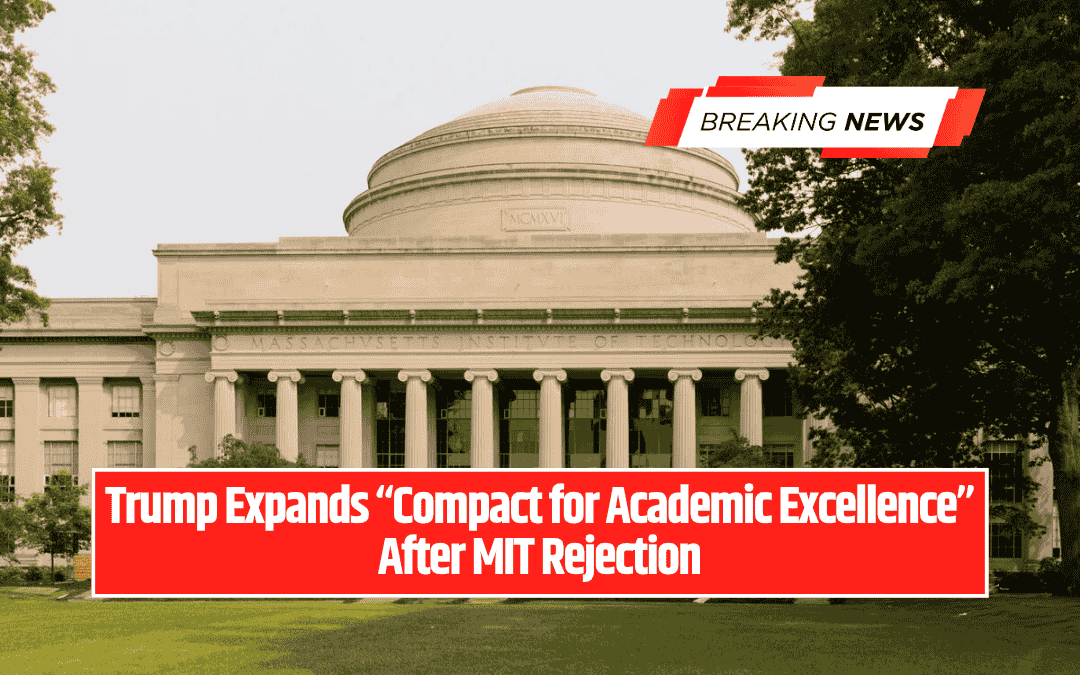
Following MIT’s public rejection of the “Compact for Academic Excellence in Higher Education,” the Trump administration has reportedly broadened the initiative to include all U.S. colleges and universities.
The proposal promises preferential federal funding in exchange for strict policy commitments, including diversity, equity, and inclusion (DEI) bans and limits on international student enrollment.
Originally, the compact was sent to nine elite universities, each given until October 20 to respond. According to a source close to the matter, the plan’s expansion is now placing pressure on the entire higher education system and could create deep funding divides among institutions.
Some universities have reportedly shown interest, though none have yet been identified publicly.
Sweeping Terms and Federal Control
The Compact for Academic Excellence outlines a series of far-reaching requirements. It would cap international undergraduate enrollment at 15 percent, with no more than five percent from any single country.
The agreement also bans DEI-based hiring or admissions practices, freezes tuition for five years, and requires institutions to share international student data with the federal government upon request.
In addition, the compact mandates the dismantling of campus units that “punish” or “belittle” conservative ideas and restricts all university employees from engaging in political speech or activity.
In return, signatory institutions would receive prioritized access to federal grants, partnerships, and research funding opportunities.
Political Motivation and Public Reaction
Announcing the expansion on social media, former President Trump stated, “Higher Education has lost its way and is corrupting our youth with WOKE, SOCIALIST, and ANTI-AMERICAN ideology.”
He added that institutions seeking to “return to the pursuit of truth and achievement” were invited to join a “forward-looking agreement” with the government to usher in a new “Golden Age of Academic Excellence.”
The White House emphasized that the compact aims to restore “academic integrity and common sense” to American universities.
A spokesperson said that any institution refusing to sign the agreement is “bowing to radical, left-wing bureaucrats” rather than serving its students.
MIT’s Rejection and Broader Silence
MIT became the first university to reject the proposal, stating that it violated the institution’s principles of academic freedom and independence. The university’s leadership asserted that research funding must be based on scientific merit, not political ideology.
Of the other eight institutions that received the original invitation, most have issued brief, noncommittal responses, noting they are still reviewing the proposal. The University of Texas system chair, however, expressed openness to participation, calling the offer an “honor.”
Expert Perspectives
Before the compact’s national rollout, higher education experts viewed the initial offer as a test case. Boston College professor Chris Glass suggested it was designed to gauge institutional reactions and inform future policy decisions.
“The administration likely intends the compact as a way to shape messaging and assess resistance,” Glass explained.
The rapid expansion of the compact has surprised observers. Many expected a limited pilot program, not a nationwide campaign.
The move could mark a significant shift in the federal government’s relationship with higher education, particularly regarding autonomy and political neutrality.
Potential Consequences for Higher Education
If widely adopted, the compact could reshape the funding and governance landscape of American universities. Schools that refuse to participate might face competitive disadvantages in research grants and federal partnerships.
Conversely, institutions that sign on could see increased funding but at the cost of academic freedom and diversity initiatives.
Critics warn that such federal conditions on education funding raise serious constitutional questions, particularly concerning free speech and institutional independence.
Advocates, meanwhile, argue that the compact restores focus to academic rigor and ideological balance on campuses long criticized for political bias.
As the October 20 deadline approaches, the higher education community awaits the responses of the remaining institutions.
With the compact’s sudden nationwide expansion, universities across the country may soon face a defining choice between autonomy and access to federal support.