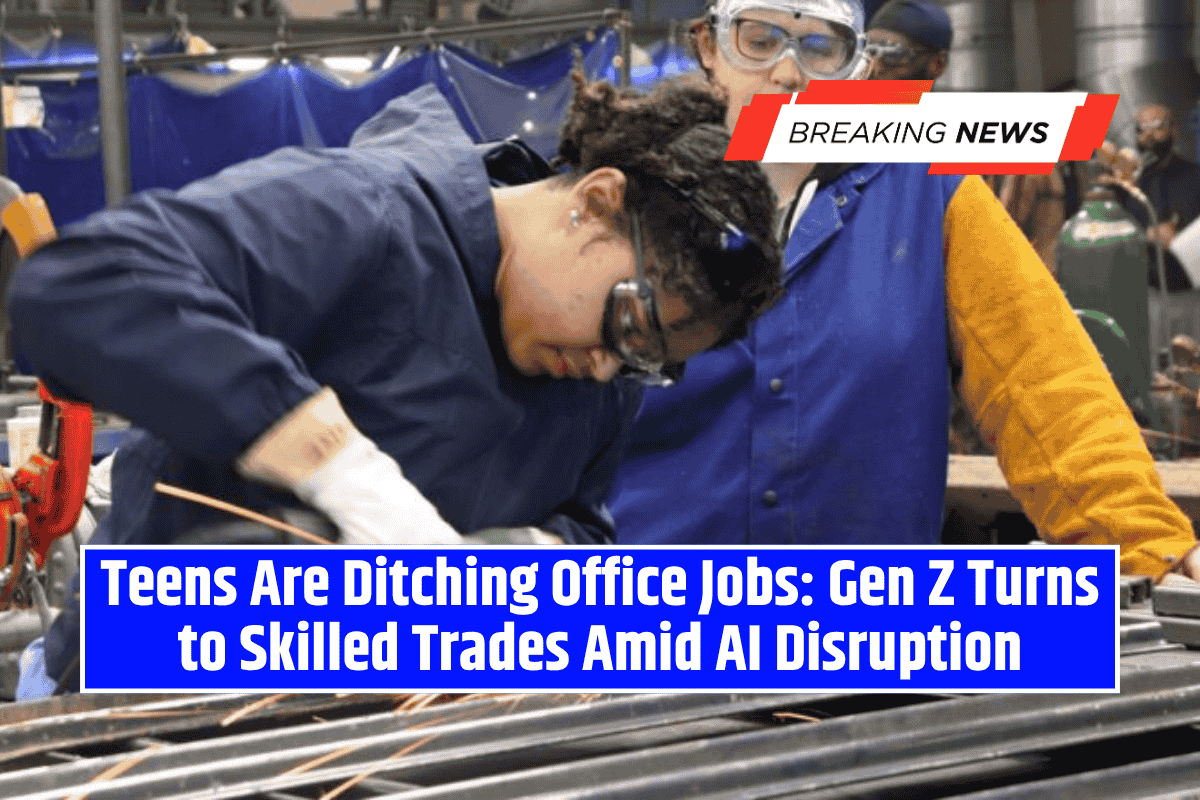
It’s noon on a Thursday at a training facility in Concord, California, and class is in session — not for algebra or literature, but for pipe fitting. A dozen apprentices, most wearing gray canvas shirts and baseball caps, study fabrication drawings at the United Association Local 342, a union that trains workers in the pipe trades.
These students are part of a growing number of young adults opting for hands-on, high-paying careers in the skilled trades. Through a five-year paid apprenticeship, they’ll graduate as journeymen earning up to $80.50 an hour — all without taking on student debt.
While many cite a desire to work with their hands and secure financial stability, a new motivator is accelerating this shift: the rise of artificial intelligence (AI) and its threat to traditional office jobs.
White-Collar Uncertainty: AI Rewrites the Career Landscape
Recent data from the Federal Reserve highlights a startling trend. Among recent college graduates:
- Computer engineering majors face a 7.5% unemployment rate.
- Computer science majors face 6.1%.
- Construction services majors, by contrast, have just 0.7% unemployment.
This reversal reflects a broader shift. As AI automates and replaces entry-level white-collar roles, job security in the trades is looking more appealing.
Anthropic’s CEO predicted earlier this year that AI could eliminate up to half of all entry-level white-collar jobs and push unemployment to 10–20% within five years.
According to a May Resume Builder survey of 1,434 Gen Z adults, more than one in four blue-collar Gen Z workers said they chose their career because it’s less likely to be replaced by AI. Similarly, a Zety study in August found 43% of Gen Z respondents have already changed career plans due to AI’s growing influence.
Vocational Training Gains Momentum
Instructors at vocational schools and union apprenticeship programs report rising interest — especially among high school graduates.
“Since ChatGPT really started taking off, that kind of opened people’s eyes,” said Jonathan Cronan, an HVAC and refrigeration instructor at San Jose Community College. “They were like, all right, this is here sooner than I thought it was going to be. I better pick a good career path.”
Microsoft’s internal research supports that sentiment, predicting that the jobs least vulnerable to AI will largely be blue-collar roles — from electricians to welders to plumbers.
The Economic Case for the Trades
Beyond AI concerns, trade work offers tangible advantages. Apprentices earn while they learn, often avoiding student debt entirely. Many are also part of unions that guarantee benefits and retirement security.
At the Electrical Training Alliance of Silicon Valley, graduates who join the local electricians’ union earn a starting wage of $91 per hour. Outreach coordinator Robert Chon says the program’s acceptance rate is just 5%, underscoring demand for these lucrative careers.
“A lot of people are retiring out of a union with good, solid pensions and even a couple million dollars in a 401(k),” said Al Garcia, training director for Local 342. “It’s pretty cool.”
The Bay Area’s concentration of universities, labs, refineries, and tech firms ensures steady demand for the skills these unions teach — from medical gas systems in hospitals to the cooling infrastructure in grocery stores.
Younger, Smarter, and More Tech-Aware
To meet growing interest, Local 342 has expanded its training capacity, but can still accept only about 10% of applicants each year. More of them are applying straight out of high school.
At San Jose Community College, Cronan said Gen Z students are now discussing AI as a factor in choosing HVAC careers. Meanwhile, about 37% of Gen Z blue-collar workers already hold a bachelor’s degree — including people like Ellen Lahey, 24.
From Academia to the Welding Floor
Lahey graduated from UC Santa Barbara with a degree in earth science, dreaming of becoming a park ranger. But when her job search led only to academic or consulting roles, she turned to welding — inspired by her father, a lifelong mechanic.
Now pursuing an associate degree in welding at Chabot College, Lahey feels more secure about her future.
“Everyone needs a welder,” she said. “The job’s not going to leave anytime soon.”
Rising tuition costs and AI’s encroachment on knowledge work are changing how young adults evaluate college’s value. The Zety study found 63% of Gen Zers believe a degree won’t protect them from AI-related job loss.
A 2023 OpenAI study reinforced that conclusion, finding AI is most capable of performing tasks held by four-year degree holders — while only 4% of jobs, like carpentry and roofing, are truly AI-proof.
AI Enters the Trades — But Slowly
Even so, the skilled trades aren’t immune to technological change.
Liisa Pine Schoonmaker, a welding instructor at Chabot College, said automation is advancing rapidly through collaborative robots, or “cobots.” These machines can replicate human welds and use AI to monitor quality in real time.
“Students might be surprised how much technology is coming into the world of welding,” said instructor Dave Vetrano. “But the vast majority of this could be a lot slower to be replaced than entry-level white-collar jobs.”
Automation is also improving safety — reducing the need for humans to weld in dangerous environments like deep-sea pipelines or nuclear facilities.
Meanwhile, AI-powered tools are emerging for electricians, helping them analyze grids and troubleshoot installations more efficiently.
“We always believed our jobs were too intricate for a robot,” said Robert Chon. “That’s still true — but some of what we do could eventually be displaced by AI paired with robotics.”
The Irony of Building the AI Future
Despite automation’s gradual spread, trade professionals remain optimistic.
“It’s going to be very hard for robots to do what humans do — at least for another 10 to 15 years, until they’re going up on rooftops and crawling under houses,” said Cronan.
For now, AI’s rise has actually created more work for tradespeople. Electricians and pipefitters are busy building AI data centers across San Jose and Santa Clara, a trend that’s boosting demand — even as those same centers house the technology that could someday disrupt their jobs.
“We’re conflicted,” Chon admitted. “We know that in building data centers, we’re developing technology that will eventually replace workers — possibly including ourselves someday. So it’s kind of a strange place to be.”
A Hands-On Future
While AI reshapes the white-collar world, many young Americans are finding stability, pride, and purpose in the trades. For Gen Z, the future of work may not be behind a computer — it may be behind a welding mask or on a construction site.
“The technology is always advancing,” Lahey said. “And it’ll be fun.”