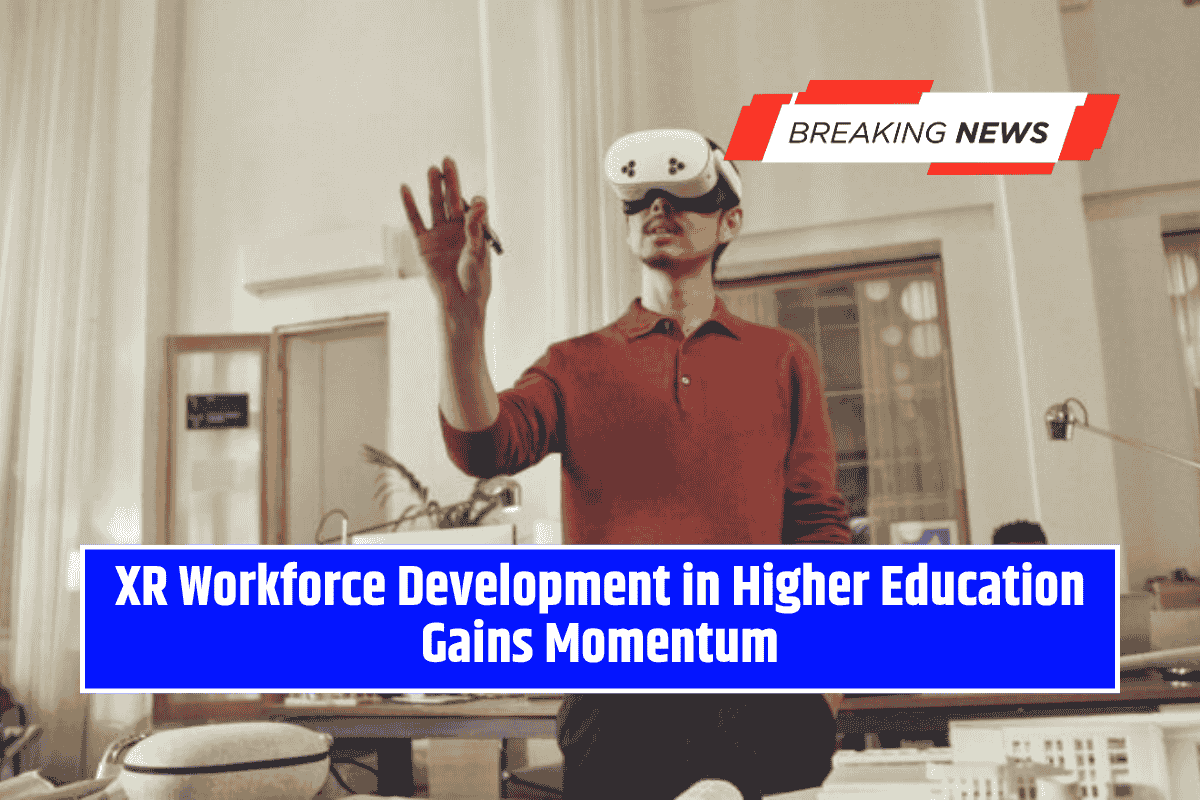
Higher education institutions are increasingly turning to extended reality (XR)—an umbrella term encompassing augmented reality (AR) and virtual reality (VR)—to modernize workforce development.
XR technology provides immersive, hands-on learning experiences that better prepare students and professionals for rapidly evolving industries.
As workforce dynamics shift, colleges and universities are reimagining traditional education models. XR technology is helping bridge the gap between old expectations and new realities, giving learners the ability to master skills and competencies in dynamic, simulation-driven environments.
Navigating a Double-Sided Technology Disruption
Artificial intelligence (AI) has redefined the job market, both disrupting employment patterns and enhancing how students learn. Combined with XR, AI is fueling adaptive, personalized, and immersive educational experiences.
Through XR simulations, learners can explore real-world scenarios, gain practical skills, and build confidence in ways traditional classrooms cannot.
Institutions are using these technologies to design workforce programs that meet the needs of both learners and employers, ultimately strengthening local economies and future talent pipelines.
The Critical Moment for XR Adoption
The rise of XR coincides with a period of technological and workforce uncertainty.
- Employers struggle to find qualified workers with the right skills.
- Graduates worry about automation and AI reshaping career landscapes.
- Employees seek ways to stay relevant through upskilling and reskilling.
A Harris Poll from the University of Phoenix revealed that 73% of HR leaders prioritize closing skill gaps. XR-enabled learning directly addresses this need by providing flexible, scalable, and skill-based educational pathways.
Diverging Career Paths and the Need for Upskilling
According to the Georgetown University Center on Education and the Workforce (2024), “good jobs” (those paying $43,000+ for younger workers and $82,000 median overall) will grow by 21% through 2031.
Key takeaways:
- 85% of these jobs will require some postsecondary education or training.
- Middle-skill pathway jobs (high school plus additional training) are increasing, while high school-only jobs are declining.
This shift highlights the importance of workforce-aligned education, where XR helps bridge gaps between classroom learning and real-world application.
Unlocking Opportunities for Institutions
For colleges and universities, XR-driven workforce development offers opportunities to engage a wider learner base, including:
- Nontraditional and returning students
- The 43 million “some college, no credential” learners in the U.S.
- Working professionals seeking microcredentials or digital badges
XR programs support:
- Work-based, industry-aligned learning
- Flexible entry and exit points for lifelong learners
- Career exploration through immersive environments
- Integrated services like skills assessments, mentoring, and placement
By embedding XR into education, institutions extend their reach and impact—empowering learners while fulfilling their core mission.
Overcoming Early XR Limitations
Earlier XR deployments faced setbacks due to high costs, limited content, and hardware issues. However, three major advancements have changed the game:
- Expanded Content Libraries – Generative AI and low-cost authoring tools now allow institutions to create vast, customizable XR content.
- Improved Hardware – Modern XR devices are durable, easy to manage, and supported by strategic vendor partnerships.
- Reduced “XR Sickness” – Enhanced display technologies and best practices (shorter sessions, better ergonomics) have nearly eliminated motion sickness concerns.
Together, these factors have created a new inflection point for scalable, impactful XR learning.
Leading the Charge: Lenovo and Industry Partnerships
Lenovo partners with educational institutions to align XR solutions with academic goals, ensuring both technical compatibility and pedagogical value. Through such collaborations, colleges can maximize technology investments, enhance faculty readiness, and support mission-critical outcomes.
Immersive Platforms Powering Workforce Readiness
Transfr
Transfr’s XR platform provides over 300 virtual training simulations across industries such as healthcare, manufacturing, and technology. Learners explore “day-in-the-life” job experiences and gain practical, transferable skills. Features include:
- Career assessments and guided pathways
- Curriculum alignment and multilingual access
- Mobile accessibility and educator dashboards
VirtualSpeech
Focusing on soft skill development, VirtualSpeech combines XR and AI to simulate public speaking, interviews, presentations, and workplace scenarios. Real-time feedback on speech, gestures, and tone helps learners improve confidence and communication—key competencies for career advancement.
Building a Foundation for Successful XR Deployment
To effectively scale XR initiatives, institutions should ensure support across three critical areas:
- Technical Infrastructure – Reliable equipment, strong connectivity, and ease of management.
- Staff Development – Comprehensive training to help educators integrate XR meaningfully into curricula.
- Funding Strategies – Leveraging grants, partnerships, and innovation budgets to offset costs.
Measuring Success: Metrics That Matter
Institutions can evaluate XR program success through:
- Engagement Metrics: Tracking participation rates and simulation time.
- Outcome Data: Measuring skill acquisition, confidence growth, and job placement rates.
- Narrative Impact: Highlighting learner success stories, especially among underserved populations.
- Institutional Benefits: Assessing equity progress, retention rates, and employer partnerships.
Selecting the Right XR Partner
Implementing XR at scale requires a strategic technology partner with:
- A proven record across hardware, software, and infrastructure.
- The ability to manage complex ecosystems and ensure maximum uptime.
Given the high stakes for nontraditional learners, reliability and continuous support are crucial.
The Future Is Immersive
As a global leader in educational technology, Lenovo is helping higher education institutions worldwide embrace the future of learning through XR. By connecting students, educators, and employers, XR transforms not just classrooms—but entire communities.
The future of workforce development is immersive, interactive, and inclusive.
The future is XR.